

Why More Features Make It Harder to Buy

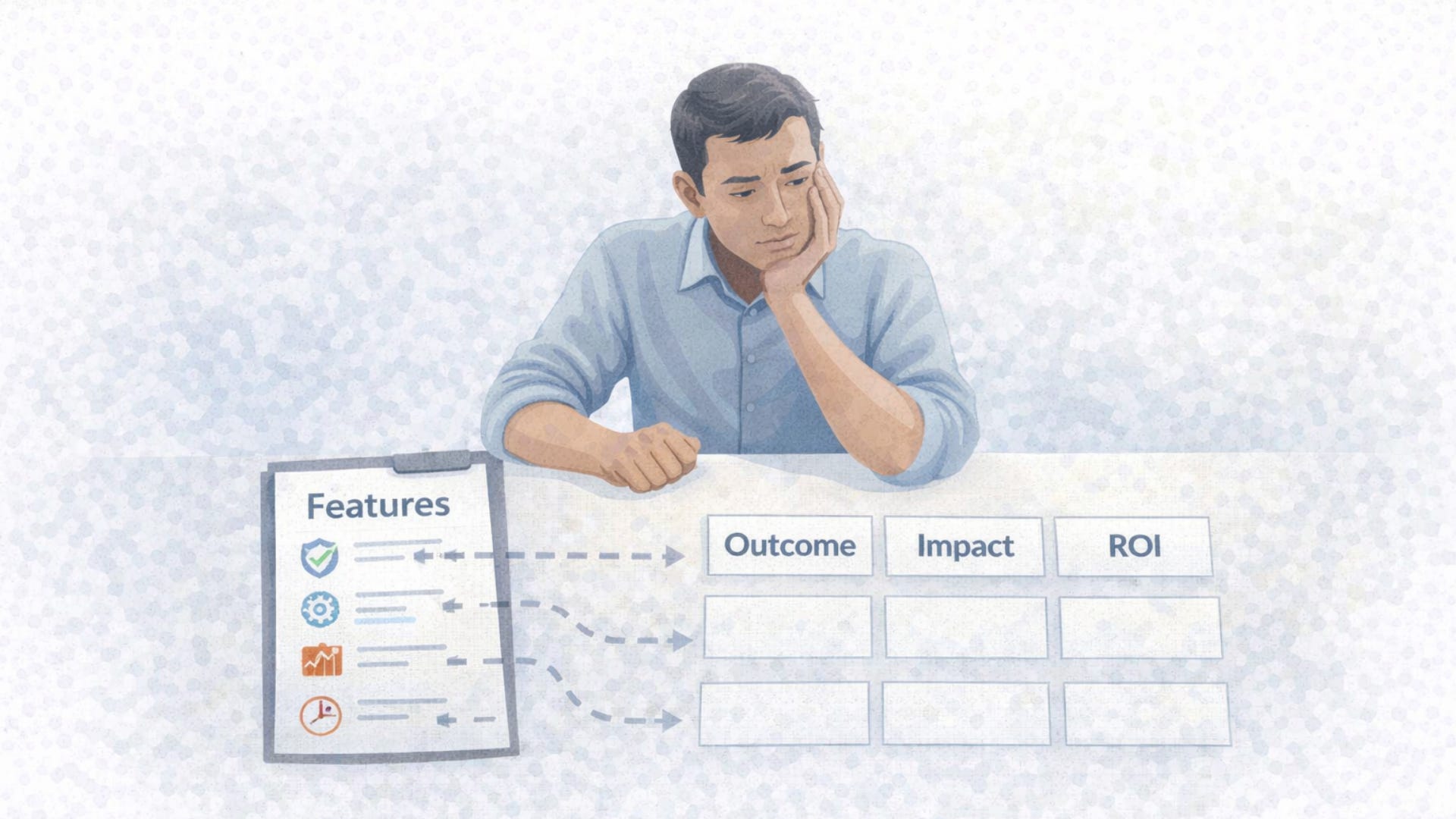
Most companies assume that adding more features makes their product more compelling.
On paper, that logic holds. More capability should increase value. More value should make it easier for buyers to say yes.
Yet many companies experience the opposite. As products become more feature-rich, sales cycles lengthen, conversion rates decline, and deals stall late in the process.
This is not a sales execution problem. It is a buyer decision problem.
Every feature you introduce creates additional work for the buyer. That work is not about understanding the feature itself. It is about interpreting what that feature means for their specific situation.
A buyer has to determine whether the feature is relevant, how it changes their outcomes, how much improvement it creates, and whether it will actually work in their environment. Each of these requires judgment under uncertainty.
As the number of features increases, the amount of this decision work increases as well.
The buyer is forced to connect capabilities to outcomes, estimate payoff, assess probability, and weigh risk. This is cognitively demanding work. When the effort becomes too high relative to the perceived benefit of deciding, buyers slow down or defer. This is where many deals are lost.
Improving sales outcomes does not start with presenting more. It starts with reducing the work required for the buyer to decide.
That requires a shift from describing products to clarifying outcomes. It requires explicitly connecting what the product does to what will change for the buyer, in a way that reduces uncertainty rather than increasing it.
Buyers do not need more information. They need less decision effort.
Every feature you present increases that effort. Companies that recognize and manage this dynamic will make it easier for buyers to commit, and will capture more of the value they already create.
Share your comments below.
Now, go make an impact!
This connects directly to what breaks most subscription models.
Companies build Good-Better-Best tiers assuming customers will connect the dots between features and value. But as you point out that decision work falls entirely on the buyer.
The result: customers don't upgrade. Not because of price resistance. Because they can't clearly answer "what changes for me if I pay more?"
Customers don't want a laundry list of features. They want to know which problem goes away.