

The Case for Token-Based Pricing

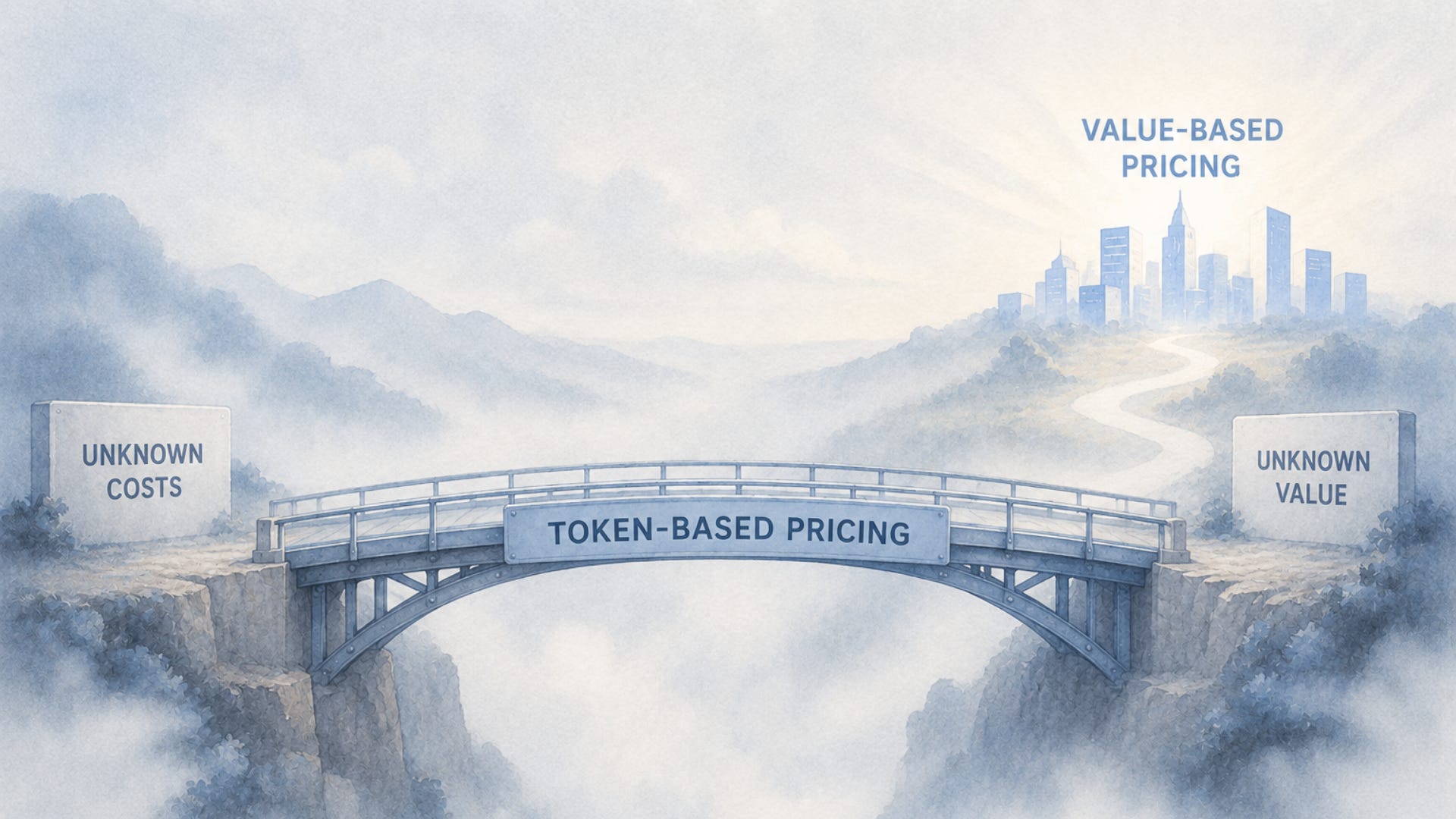
I’ve spent decades arguing against cost-plus pricing, and token-based pricing is simply cost-plus. So when I say token-based pricing makes sense right now, I want you to understand how much it pains me to type that.
Here’s the argument.
Value-based pricing requires three things:
The seller needs to know their costs.
The seller needs to know what the solution is worth to the buyer.
The buyer needs to believe that value is real.
When any of those are missing, value-based pricing isn’t principled. It’s a guess dressed up as a strategy.
With AI agents today, all three are missing.
Sellers don’t yet have a clear handle on their costs. Inference costs are falling fast and unpredictably. The compute required to complete a task varies widely depending on complexity. A seller who commits to a fixed price before understanding their cost structure is taking on enormous financial risk. Token-based pricing solves that problem directly. It ties revenue to consumption, which ties revenue to cost. Margins are thin, but the seller isn’t flying blind.
Think about hourly billing. A contractor charging by the hour on a novel project isn’t being lazy. They’re being honest about cost uncertainty. They don’t know how long it will take, so they price by the unit of input they can measure. Token-based pricing works the same way. It’s the honest answer to “we don’t know what this costs to deliver yet.”
The value side is equally uncertain. Agents are being deployed to do things that haven’t been done before in ways that haven’t been measured before. The buyer genuinely doesn’t know what a successful outcome is worth yet. And a seller who can’t point to proven outcomes can’t credibly name a value-based price. Both sides are still figuring it out.
There’s another dynamic worth naming. Charging by the hour, or by the token, transfers risk from the seller to the buyer. The buyer absorbs the uncertainty of not knowing how much they’ll spend or what they’ll get. Sellers make that risk acceptable by keeping margins low. It’s not generosity. It’s the price of asking the buyer to carry the uncertainty while the market figures itself out.
This doesn’t mean token-based pricing is the right long-term answer everywhere. LLMs selling platform access may reasonably stay token-based for a long time because the use cases are so varied that value is genuinely hard to pin down at the platform level. But that doesn’t mean LLM companies can’t also carve out high-value niches, specific applications where outcomes are measurable and value is clear, and price those based on value while keeping the platform token-based.
For agents the timeline is shorter. Agents are built to accomplish specific tasks, which means outputs become visible faster. And once outputs are visible, value isn’t far behind. The right pricing metric will move toward something buyers understand in their own business terms. Not tokens consumed, but decisions automated, errors caught, hours recovered, revenue influenced.
Token-based pricing may be the right place to start. It should not be the place you stay.
If you want help thinking through value to your buyer, let me know. It’s our superpower.
Share your comments below.
Now, go make an impact!
The answer to your question is in your comment. There is a difference between tokens and credits. Tokens are a pricing metric. Credits are a translation between money and a pricing metric. You are absolutely right that credits do not have to be cost-plus.
Value IQ uses credits. And the pricing metric you're translating to isn't tokens. ValueIQ uses creating a deal, adding a product, adding a verified product, adding a team member, etc. as pricign metrics. At no point does ValueIQ sell tokens (that I can find).
Really enjoyed this. One nuance I’d add is that AI companies are not all solving the same pricing problem.
LLM owners (OpenAI, Anthropic, Google) have models that can do almost anything. When your platform spans thousands of use cases, tokens become the only common denominator across all of them. In that sense, token pricing is less a choice and more a consequence of having an extremely horizontal product. That said, even they are already experimenting with price skimming via model tiers and premium access to frontier models (e.g., Claude’s so many models with different API pricing)
What’s interesting is what the application layer is doing. Companies like Glean, Dust, and GitHub Copilot don’t own the underlying models, so many are introducing artificial currencies such as AI Credits, Flex Credits, or that sort. They’re no longer monetizing tokens directly, they’re monetizing different actions on their platforms not directly correlated with cost.
To me, that’s the first step toward outcome-based pricing. Not because they’ve figured out outcomes yet, but because they’re moving the pricing metric closer to how customers actually consume value.